
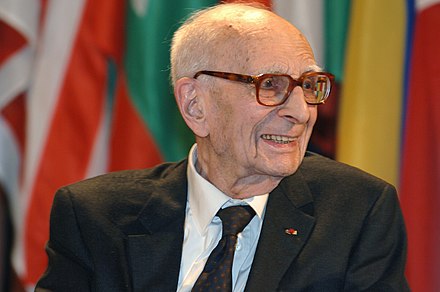
Lisa and I were assigned a passage titled, “The Culinary Triangle” by Claude Levi-Strauss. At first glance, the passage was very convoluted and confusing. To start the passage, there was an extended metaphor between language and food that I didn’t feel like it needed to be there. After three quarters of a page of that extended metaphor, the passage finally gets into the nuts and bolts of the main idea. Claude talks about the triangle of cooking, from raw to either smoked or boiled. He then goes into how culture determines whether or not the meat is boiled or smoked. This concept, as well as many others in this passage can be hard to pick up on the first time reading. Subsequent readings helped me
comprehend what Claude wa
s trying to say. He mentioned that boiled food, in many cultures, is for family, while smoked and roasted meat is for special circumstances and when you need to serve guests at an event. Claude then spoke about cannibalism for a short paragraph, which still seems very random to me. He talks a
bout how there are two types of cannibalism, exo and endo cannibalism. Exo refers to eating ones enemies, while endo refers to eating ones family. I believe he was trying to relate this concept to boiling meat being served to the in-group, or endo feasts, while the exo cannibalism refers to feeding guests. Claude then talks about the gender stereotypes in relation to food. He says that the smoked and roasted are for the men, and boiled is for the women. He makes this statement because, traditionally in tribal groups, the men would be out hunting and they could only build a fire and find a stick to skewer through the meat, and their only option was roasted or smoked. Women on the other hand would stay in the home and they had a recepticle to put the meat in along with some water, so they had an opportunity to boil it. Yet another point that Claude makes is that the triangle he proposes
may not be triangle at all. He states that another facet of the “triangle” could be smoking meats. He then breaks it down into a diagram that starts with raw meat, then splits off into two sec
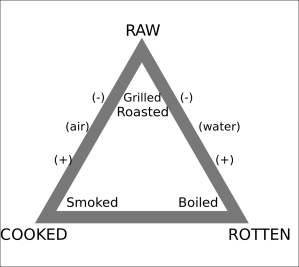
tions. The first being air, and the second being water. Within that first section, it splits f
urther into two more sections, one being when there is lots of air in between the meat and fire, which is smoked, and the other section is when there is no air between the meat and fire, and that is roasted. He states that this triangle can keep expanding as society finds new ways to cook, but Claude does a very good job of comparing food to concepts like; life and death, language, and culture. This first time reading through this passage is very hard, but after reading it multiple times, you can start to pick up on the subtle comparisons that are made.
 Ryan Sanders' blog