
When I first started taking these FIG classes, I had no idea why these three were linked up. The three seemed to different. Agroecology, Anthropology and the Food Culture class? It seemed to random. But after a month, I can completely see why they are linking. Anthro looks into the culture of humans while AgroEcology looks at how important agriculture and the structure of Agriculture is. There is a culture to food and a culture to agriculture. There is an importance of food in culture, and society has a say in how agriculture is performed. This all came into fruition last week, when we had a speaker who participated in Community Supported Agriculture and yet again when the author of The Culinary Triangle, an article I read, was introducing a famous anthropologist, Franz Boas.
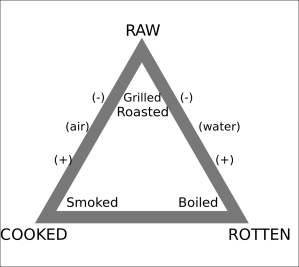
The Culinary Triangle is, in essence, a way of thinking that tries to explain the culture of how we cook food. Claude Levi Strauss, the author, was a famous French anthropologist, a
nd did major work in convincing people that the “savage” mind and the “civilized” mind are the same. The Europeans and the other are the same mind. He helped shape the way we think about people who are not the same. Strauss was widely regarded as one of the most influential anthropologists of his time. At the time reading The Culinary Triangle, I had a hard time picking out the motives behind the reading, and why this author would be trying to relate food to culture, but in hindsight, I completely understand why. Food and culture go hand in hand.

Michelle Miller was one of our guests who helped us create a very convenient meal of pesto and pasta. She talked a lot about Community Supported Agriculture, where you pay a fee, and the farmers will give you a box of vegetables. It usually is whatever is in season. In our agro lecture the very next day, we had Mike Bell as a speaker, and he spoke in great length about a farm up north by Lake Superior. They were an organic farm and they oftentimes participated in a CSA. It sort of completed the cycle for me. In agroecol
ogy, we talk about what agriculture is and how it interacts with the world, but had I not taken the FIG, it would have just stopped there. In Food Culture, we are the consumers, and what we do as consumers is so dependent on farmers and what they choose to do. Its crazy to see both ends of the spectrum.
 Ryan Sanders' blog